


Every IPO season, the same number starts doing the rounds: the IPO GMP. It shows up in group chats, finance reels and tracking sites, usually next to words like “sure shot” or “avoid.” Plenty of people apply because of it, and plenty don’t know where it comes from or who sets it.
[Author: add two or three lines of your own here, such as an IPO you applied to because of the GMP, or a listing that went the other way. Delete this note before publishing.]
This guide explains what the number means, how to work with it, and where it misleads. Treat it as one piece of IPO grey market premium information, not as a verdict.
Introduction to IPO grey market premium
When a company is about to list, its shares don’t trade on any exchange yet. But some dealers and traders start quoting a price anyway, based on how much demand they expect. The gap between that informal price and the issue price is what people call GMP.
Investors follow it because it’s quick. One number seems to say how excited the market is. That’s true as far as it goes: it indicates unofficial sentiment. It says very little about whether the company is good or the price is fair, and sentiment and listing performance aren’t the same thing.
What is IPO GMP?
If you’re asking what is IPO GMP, the short answer is that it’s the premium, in rupees, at which an IPO’s shares or application entitlements trade in the grey market over the issue price, before listing.
Reading the sign is simple:
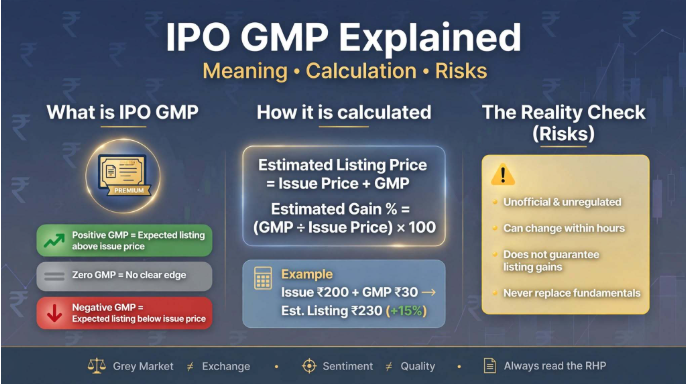
- Positive GMP: traders expect the shares to list above the issue price.
- Zero GMP: traders see no clear edge either way, so they expect a listing near the issue price. It can also mean there’s too little trading to quote a number.
- Negative GMP: also called a discount. Traders expect a listing below the issue price.
Don’t confuse it with the official price. The issue price is set by the company and its bankers, within the IPO price band for book-built issues, and it’s fixed after bidding closes. GMP is nobody’s official price. It’s a guess made by a handful of dealers.
How does the IPO grey market work?
How IPO GMP works is easy to describe: it’s an informal market. Dealers and brokers agree to buy and sell IPO entitlements among themselves. There’s no exchange, no clearing house, no official record and no regulator supervising it. Deals run on trust, and settlement happens after listing or allotment.
Buyers expect the shares to rise and want exposure before listing. Sellers want to lock in a price now, or they’re dealers taking the other side. If many want to buy and few want to sell, the premium climbs. If interest dries up, it falls. That’s why GMP isn’t a stock exchange price. Nobody can verify it, and a small group can nudge it.
How is IPO GMP calculated?
You don’t calculate GMP itself, because it’s quoted by the market. What you calculate is the estimated listing price and the estimated gain. If you’re wondering how to calculate IPO GMP-based estimates, the formulas are:
Estimated listing price = issue price + GMP
Estimated gain (%) = (GMP ÷ issue price) × 100
A hypothetical example. Say an IPO has an issue price of ₹200 and a quoted GMP of ₹30. The estimated listing price is ₹230, and the estimated gain is 30 ÷ 200 × 100 = 15%. If one lot is 75 shares, the lot costs ₹15,000, and the notional gain is ₹2,250.
Now suppose the premium shrinks to ₹5 before listing. The estimate drops to ₹205, a gain of 2.5% or ₹375 per lot. If it flips to a discount of ₹10, the estimate is ₹190, a loss of 5%.
The limits matter as much as the maths. The number is unofficial and moves constantly. It ignores brokerage, taxes and other costs. And it assumes you get shares at all. If an issue is oversubscribed, retail allotment often goes by lottery, so a high GMP doesn’t mean your application will be successful.
Different types of grey market transactions
Three terms come up whenever people talk about the grey market, and they aren’t the same thing.
IPO GMP is the premium on the share, shown as the gap over the issue price. It’s what most tracking sites display.
The Kostak rate is a fixed amount a dealer pays you for your IPO application, whether or not you’re allotted shares. Essentially you sell the application itself. You get the amount regardless of the outcome, and the dealer takes on the allotment result.
Subject to Sauda is a deal where the premium is payable only if you’re allotted shares. If you get nothing, you get nothing. The “sauda” is conditional on allotment.
All three live in the same unofficial market, with the same caveats.
What factors affect IPO GMP?
A handful of things move the number.
Company financial performance matters, since steady revenue, healthy margins and manageable debt attract more interest than weak numbers. IPO valuation and price band matter too: when the price looks stretched against listed peers, premiums tend to shrink once people do the arithmetic.
Investor demand and subscription numbers feed it directly. Heavy bidding, especially from institutions, pushes premiums up, and a weak response drags them down. Market conditions add colour, since an IPO in a rising market often sees higher premiums than the same IPO in a falling one. Industry growth prospects count when a sector is fashionable, and overall investor sentiment can lift or sink every issue at once.
Why is IPO GMP important for investors?
It isn’t, in the sense that you must follow it. It’s useful in a few narrow ways.
It’s a gauge of market mood. If the premium is strong, it tells you other people are interested, which can affect how the shares open. It also shows unofficial demand before exchange data is available. And it gives you a rough sense of potential listing expectations, which matters mainly if you plan to sell soon after listing.
The sensible way to use it is as a cross-check. Look at the company’s fundamentals first, then see whether the premium makes sense. A strong premium on a profitable company with a reasonable price is one thing. The same premium on a loss-making company at a steep valuation tells you excitement may be running ahead of the facts. For a running view of premiums and estimated listing prices, tracking pages such as Malik Times IPO GMP can help, as long as you note the update time and compare with a second source.
Risks and limitations of IPO GMP
IPO GMP risks are worth listing plainly.
There’s no guarantee of listing gains. A premium is a prediction, and predictions fail. The data is unofficial and may be unreliable: there’s no audit and no standard. Prices can swing within hours. Some information is deliberately misleading, because people with a stake in an issue can hype it. And the grey market sits outside SEBI’s oversight, so dealings there aren’t protected, and you’d have no recourse if a counterparty didn’t pay.
The deeper risk is behavioural. GMP can make an IPO feel safe, so people skip the research. It should never replace fundamental analysis.
IPO GMP vs IPO subscription status
These two get mixed up constantly. IPO GMP measures informal demand and expected listing price, and it comes from dealers. IPO subscription status measures official demand: how many times the shares on offer have been bid for, as published by the exchanges.
Subscription is broken into categories. Qualified institutional buyers (QIBs) are large funds that do their own research. Non-institutional investors (NIIs) are wealthy individuals and companies. Retail investors bid up to ₹2 lakh. Strong QIB demand generally tells you more than a heavily oversubscribed retail category.
Both have limits. Subscription shows demand during the issue, not what the shares will be worth later, and a heavily subscribed IPO can still list flat. GMP can disagree with subscription, with a high premium and tepid institutional demand, or the reverse. When they conflict, take that as a prompt to look harder at the fundamentals, not a reason to choose the one you prefer.
IPO GMP vs actual listing price
IPO GMP vs listing price is where the lesson sits. The estimated listing price from GMP is only that: an estimate. The real price comes from the exchange on listing day, set in a special pre-open session where buy and sell orders are matched.
Several things cause gaps. Sentiment can change between the last grey market quote and listing day. The wider market can move overnight. Grey market trading is thin and easy to push. And listing-day orders depend on who really wants the shares at that moment.
Two real examples from November 2026 show both directions. HGS (India), an SME issue priced at ₹120, had a last GMP of ₹27, implying about ₹147, and listed at ₹160. That’s a positive surprise. In the other direction, Antala Industries, an SME issue, reportedly listed at ₹52.80 against an issue price of ₹66, about 20% lower, even though its GMP had been quoted at ₹0. These come from tracking sites, so verify exact figures on the exchange. The point is that the grey market missed in both directions.
For the latest quotes, you can check https://maliktimes.in/ipo-grey-market-premium-latest-ipo-gmp/, but treat any number as a snapshot.
How to evaluate an IPO beyond GMP
Good research starts with the Draft Red Herring Prospectus (DRHP) and the Red Herring Prospectus (RHP). You don’t need every page. Focus on these.
Revenue and profit growth. Look at three years, not one. Rising revenue with shrinking margins can mean growth is being bought with discounts or advertising.
Debt and liabilities. A heavily borrowed company has less room for a bad year. Check operating cash flow too, since a company can show profit while burning cash.
Promoter background. Check how much promoters will hold after listing, whether any shares are pledged, and any past regulatory action or litigation.
Company valuation. Compare the price-to-earnings ratio at the top of the price band with listed peers. If peers trade at 25 times earnings and the IPO asks for 45, the company has to grow much faster to justify it.
Industry outlook. Some sectors grow for a decade, and some ride a short wave.
IPO objectives and use of proceeds. The “objects of the issue” section tells you where the money goes. Funding expansion is a bet on growth, repaying debt is housekeeping, and “general corporate purposes” tells you almost nothing. Check whether the issue is a fresh issue, where the company keeps the money, or an offer for sale, where existing shareholders cash out.
Risk factors. Skip the generic ones that appear in every prospectus and read the specific ones: customer concentration, dependence on one supplier, pending cases.
To see which issues are coming up and confirm dates and price bands, the upcoming IPO list on Malik Times is a convenient starting point, but verify final details against the exchange notice or the RHP.
Frequently asked questions about IPO GMP
1. What does IPO GMP mean?
It’s the unofficial premium or discount at which IPO shares trade in the grey market before listing, compared with the issue price.
2. Is IPO GMP an official market indicator?
No. It isn’t published or regulated by SEBI or the exchanges.
3. How accurate is IPO GMP?
Not reliably. Sometimes it’s close to the listing price, and sometimes it misses by a wide margin.
4. Can IPO GMP predict listing gains?
Not dependably. It reflects sentiment at one moment, and many things can change before listing.
5. What does negative IPO GMP indicate?
Traders expect the shares to list below the issue price. It can still change before listing.
6. When does IPO GMP start?
Quotes usually appear after an IPO is announced, often before the price band is final, and become more active as the issue opens.
7. What is the difference between GMP and Kostak rate?
GMP is the premium on the share. The Kostak rate is a fixed amount paid for your application, whether or not you’re allotted shares.
8. Does high IPO GMP mean an IPO is worth investing in?
No. A high premium says traders are excited. It doesn’t say the company is good or fairly priced.
9. Can IPO GMP change before listing?
Yes, and often does, sometimes within hours.
10. Should investors rely on IPO GMP before applying?
No. Use it as one input beside the company’s financials, valuation and your own risk tolerance.
Conclusion
IPO GMP gives you a rough read of unofficial market mood, and that’s all it does. It can help you see how excited traders are, but it can’t tell you whether a company is sound, whether the price is fair, or whether you’ll be allotted shares. Fundamentals and risk assessment matter more. Read the prospectus, compare the valuation with peers, and decide how much loss you could live with. Then let the grey market be a footnote. For ongoing coverage of premiums and issues, Malik Times is one source you can follow alongside official exchange data.
This article is for general information and isn’t investment advice. Grey market dealings are unregulated, and IPO investing carries risk. Consider speaking to a SEBI-registered advisor before investing.